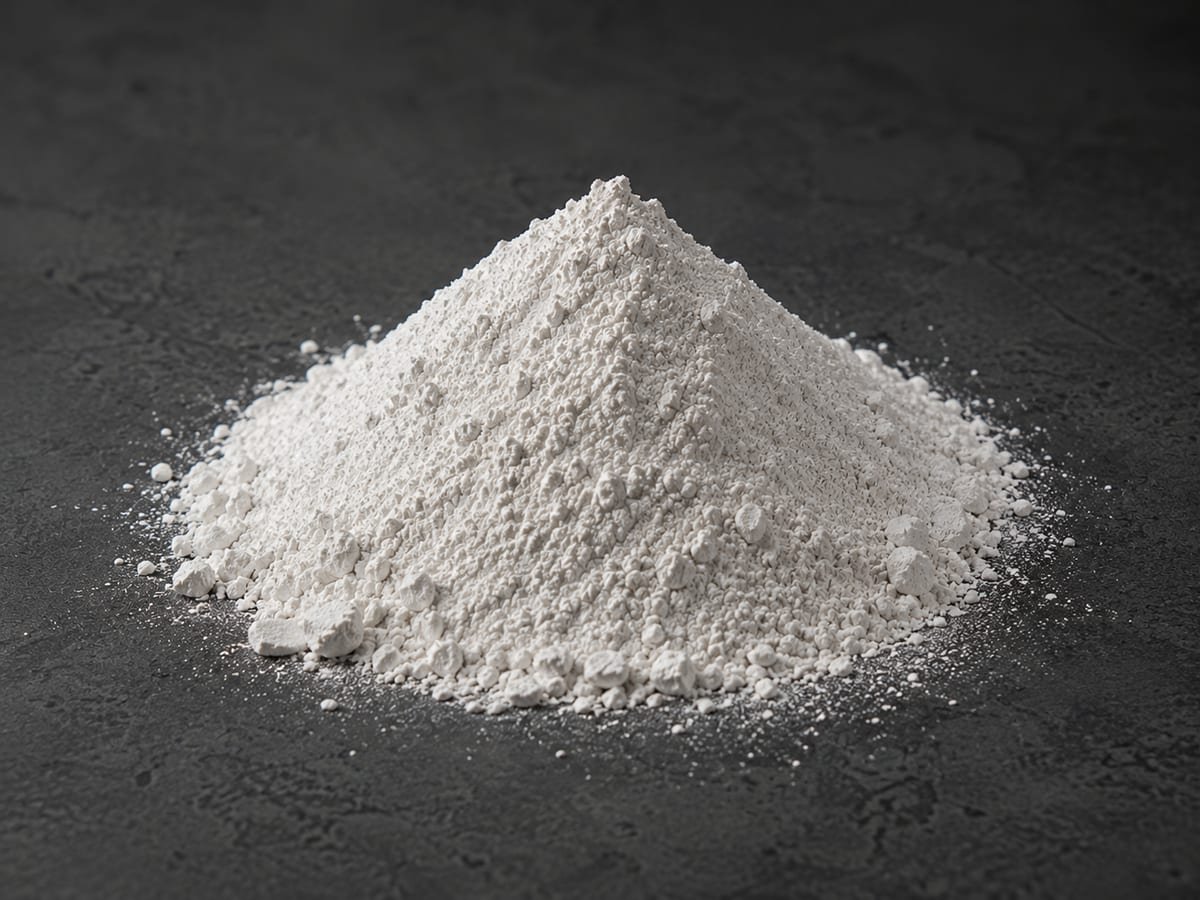
Coating gloss and smoothness aren’t achieved by picking “fine” pigment in general — they depend on a specific, documented particle size threshold, and on choosing between kaolin and calcium carbonate for reasons that go beyond size alone.
Root Causes
Coating-grade mineral pigments are documented with a specific particle size target: 85-99% of particles below 2 microns equivalent spherical diameter, with median particle sizes in the 0.5-2 micron range depending on end-use requirements — a narrow, testable specification rather than a general “fine grind” instruction. Within that fine-particle category, the relationship to gloss is direct and documented: the greater the proportion of particles finer than 2 micrometers in a kaolin coating clay, the smoother and glossier the resulting coating.
Kaolin and calcium carbonate deliver gloss and smoothness through different mechanisms, which is why paper mills use both rather than treating them as interchangeable fine powders. Kaolin’s platelet morphology is documented as delivering strong light scattering, excellent coating rheology, and superior gravure print performance, with its flat platelet orientation specifically improving surface uniformity, gloss development, and print resolution while supporting stable rheology at high solids levels. Calcium carbonate, by contrast, is documented as dominating alkaline papermaking and providing higher intrinsic brightness — often exceeding 96% ISO — meaning the choice between the two pigments (or the ratio blending them) is driven by whether gloss/print-resolution performance or brightness is the priority for a given grade.
What This Means for Raw Material Selection
Because gloss depends on a specific sub-2-micron particle fraction rather than a general fineness impression, and because kaolin and calcium carbonate achieve their coating benefits through different physical mechanisms, a buyer specifying coating pigment needs both the particle size distribution data and clarity on which pigment’s mechanism actually serves the target grade’s priority.
The practical points for a buyer are: specify the sub-2-micron particle fraction explicitly (targeting the documented 85-99% range) rather than a generic “fine” grade designation, since this is the specific parameter documented as driving gloss; select kaolin specifically when gravure print performance and platelet-driven surface uniformity are the priority, and calcium carbonate specifically when intrinsic brightness above 96% ISO is the target, rather than treating the two pigments as interchangeable; and evaluate coating formulations using a blend of both pigments when a grade needs to balance gloss/print-resolution against brightness, since the documented mechanisms are complementary rather than competing.
Sources: ChemTradeAsia technical article on kaolin clay structure and properties for paper manufacturing; ResearchGate peer-reviewed research on coating structure with calcium carbonate pigments and its influence on paper and print gloss; USPTO patent literature on kaolin and calcium carbonate pigment compositions for paper coating documenting particle size specifications and coating performance mechanisms.