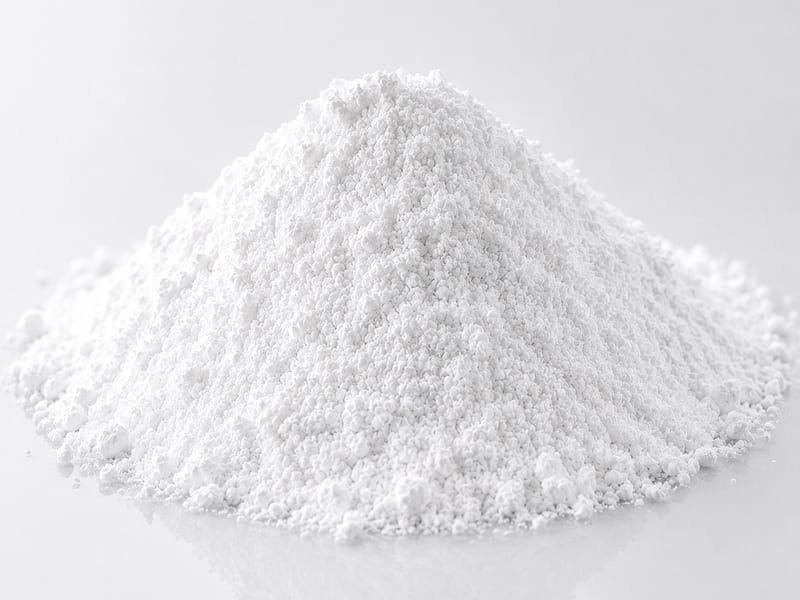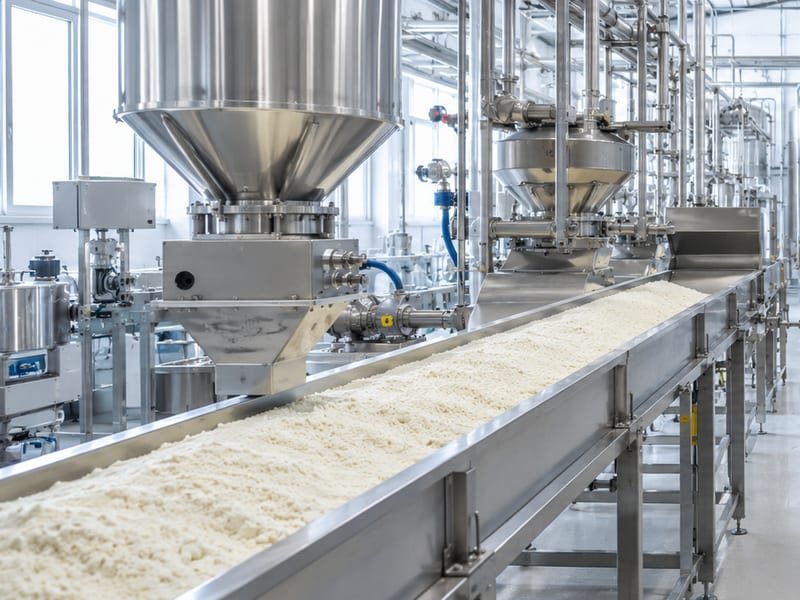
A powdered food ingredient that flows freely out of the bag in a dry warehouse can still cake into unusable clumps after a humid transport leg or a few weeks of variable storage — moisture, not the powder’s chemistry alone, is what drives caking, and anticaking performance depends on how the additive interacts with that moisture, not just how much of it is added.
Root Causes
Caking in deliquescent or moisture-sensitive powders happens when ambient humidity lets water form liquid bridges between particles; as those bridges dry and re-form through humidity cycling, particles fuse together into hardened clumps that resist normal handling and dosing equipment. Precipitated silica addresses this at the particle-surface level: its surface carries abundant silanol groups that are hydrophilic and readily adsorb water vapor through hydrogen bonding, and its high specific surface area — commonly reported in the range of roughly 50-400 m²/g depending on grade — gives it substantial capacity to do so, with some grades documented to adsorb 5-15% of their weight in water at 77% relative humidity before performance degrades.
That adsorption capacity is what prevents caking mechanistically: by capturing ambient moisture at the silica particle surface, precipitated silica keeps water activity at the interface between the surrounding food powder’s own particles below the threshold where liquid bridges would otherwise form. Separately, the fine, discrete particles physically coat and separate the larger powder particles they’re blended with, creating a mechanical barrier that reduces direct particle-to-particle contact — a second, complementary mechanism alongside the moisture-adsorption effect.
What This Means for Raw Material Selection
Because both surface area and particle characteristics determine how much moisture-buffering and physical separation a given precipitated silica grade actually provides, anticaking performance is not solely a function of dosage percentage. A grade with lower specific surface area needs a higher dosage to deliver the same moisture-adsorption capacity as a higher-surface-area grade, and dosage alone doesn’t compensate for a grade whose particle characteristics aren’t suited to the specific powder being protected.
For a buyer specifying an anticaking agent for a humidity-sensitive powdered food product, the practical implications are: confirm the specific surface area of the silica grade being sourced, since this — not just the nominal “anticaking agent” designation — determines moisture-buffering capacity per unit dosage; and validate anticaking performance under the actual humidity and storage conditions the finished product will see (transport, seasonal storage, packaging permeability), rather than assuming a dosage that worked in one climate or packaging format will transfer directly to another, since real-world caking risk depends on the interaction between silica grade, dosage, and the powder’s actual moisture exposure.
Sources: general industrial and food-additive technical literature on precipitated silica anticaking mechanisms, specific surface area, and moisture adsorption capacity; peer-reviewed research on anticaking agents, storage conditions, and moisture sorption/caking behavior in deliquescent food ingredients.