
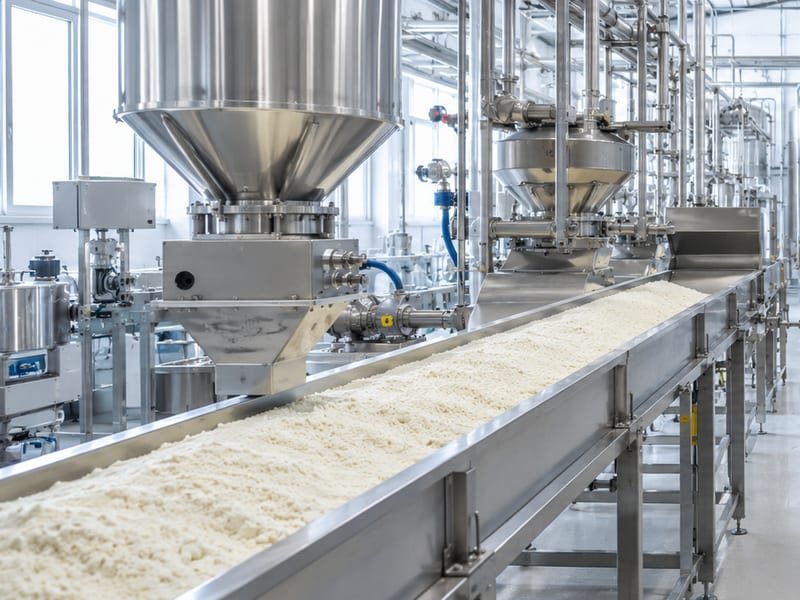
A “fortified with calcium” label claim is only as accurate as the assumed calcium content of the fortificant used to hit it, and that assumed number can drift from what a specific batch actually delivers if purity isn’t verified per lot.
Root Causes
Calcium carbonate’s function as a fortification ingredient depends on a specific, assumed calcium yield per unit of material added to the formulation — a food manufacturer’s label claim is calculated backward from that assumed purity figure, not measured directly in the finished product batch by batch. When the actual calcium carbonate purity varies from the figure used in that calculation, the gap between the assumed and actual calcium content shows up as a discrepancy between the label claim and what a lab analysis of the finished product would find, even though the formulator followed the recipe exactly as written.
This isn’t a hypothetical risk category — calcium carbonate purity is documented as varying meaningfully depending on grade and source, which is precisely why food-grade material is specified and tested against tighter purity thresholds (commonly 99% or higher) than industrial grades, with regulatory food-safety testing built into the qualification process specifically to catch this variability before it reaches a finished product. Because fortification dosing math is a direct multiplication of assumed purity by dosage rate, even a modest purity shift compounds into a measurable calcium-content shift in the finished product — the kind of shift that shows up when a regulator or independent lab verifies a label claim against actual content.
What This Means for Raw Material Selection
Because label-claim accuracy is a direct function of per-batch calcium carbonate purity rather than the nominal grade specification alone, a manufacturer relying on a single historical purity assumption across all incoming lots is carrying label-accuracy risk that a per-batch verification step would catch.
The practical points for a buyer are: verify actual calcium content via certificate of analysis for each incoming lot rather than assuming the qualification-sample purity figure holds across all future shipments, since purity is documented as a real source-to-source and lot-to-lot variable, not a fixed constant; recalculate fortification dosing against the actual per-batch purity rather than a standing formulation assumption whenever a new lot’s COA shows meaningful deviation, since the label claim is only as accurate as the assumption feeding the dosing math; and treat food-grade purity specification (99%+ typical) as the practical floor for fortification applications specifically, given that regulatory testing at that purity level is what supports defensible label accuracy under independent verification.
Sources: general food-fortification and quality-assurance technical literature on calcium carbonate purity specification and label-claim accuracy; Tanky Mineral and Sudarshan Group technical guides on food-grade versus industrial-grade calcium carbonate purity thresholds; EFSA-referenced technical assessments on calcium carbonate purity specifications for food-additive use.
