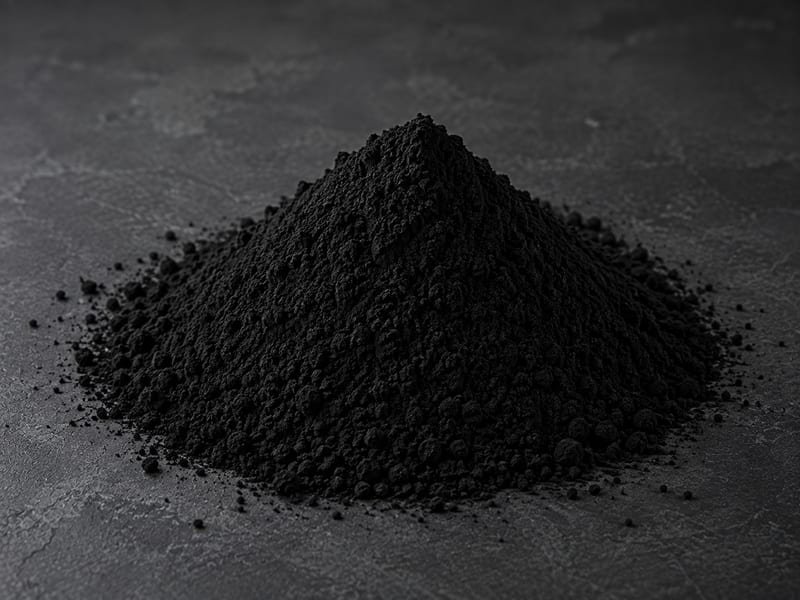
Black ink sitting in a storage drum or press reservoir for an extended period is documented as more prone to settling than other ink colors — a specific gravity and particle-size effect, not a formulation flaw, but one that has real consequences if a buyer isn’t watching for it before reuse.
Root Causes
Pigmented ink has a general tendency for the color agent to settle out over time, a documented phenomenon referred to directly as “sedimented ink” in the technical literature, and when it happens the ink drawn from the top of a container ends up carrying proportionally more vehicle and less pigment than intended, while pigment concentrates lower down. Carbon black is specifically implicated as a higher settling risk relative to other ink colorants: black ink pigment particles are documented as greater in diameter, weight, and quantity than those in typical yellow, magenta, or cyan formulations, and pigments with relatively higher specific gravity are documented as settling toward the bottom or lower portion of a storage or reservoir container during periods of non-use.
The consequence compounds rather than staying static: as pigment settles, the lower portion of the container becomes locally concentrated and enriched with pigment, which increases local viscosity in that zone — settled black ink specifically is documented as capable of reaching a viscosity high enough to clog delivery nozzles or metering systems when that concentrated layer is drawn back into use without adequate remixing. Sediment layers of several millimeters’ thickness are documented as forming at the bottom or sides of a storage container after extended settling, a physically measurable outcome rather than a vague quality concern.
What This Means for Raw Material Selection
Because settling risk is tied to a specific, documented combination of particle size, quantity, and specific gravity rather than being a generic “ink ages” concern, black ink formulations deserve more deliberate storage and agitation planning than lighter-loaded colors, not the same handling protocol applied uniformly across the color range.
The practical points for a buyer are: build re-agitation into the standard handling procedure for black ink specifically before drawing from storage or a press reservoir that’s sat idle, since the documented settling tendency is higher for black than for typical process colors; treat a measurable sediment layer or a viscosity gradient between the top and bottom of a container as an expected physical outcome to check for on long-idle black ink, not a sign of a defective batch; and factor carbon black particle size and loading into storage-stability qualification specifically, since finer, better-dispersed grades and appropriately formulated loading levels are the raw-material-side lever available to reduce settling tendency before it reaches the point of nozzle-clogging viscosity.
Sources: USPTO patent literature on inkjet recording ink and modified carbon black dispersion documenting pigment settling mechanisms, specific gravity effects, and black-ink-specific settling tendency versus color inks; PrintWiki technical reference on sedimentation in printing ink; NCBI Bookshelf technical reference on printing processes and printing inks covering carbon black pigment behavior.