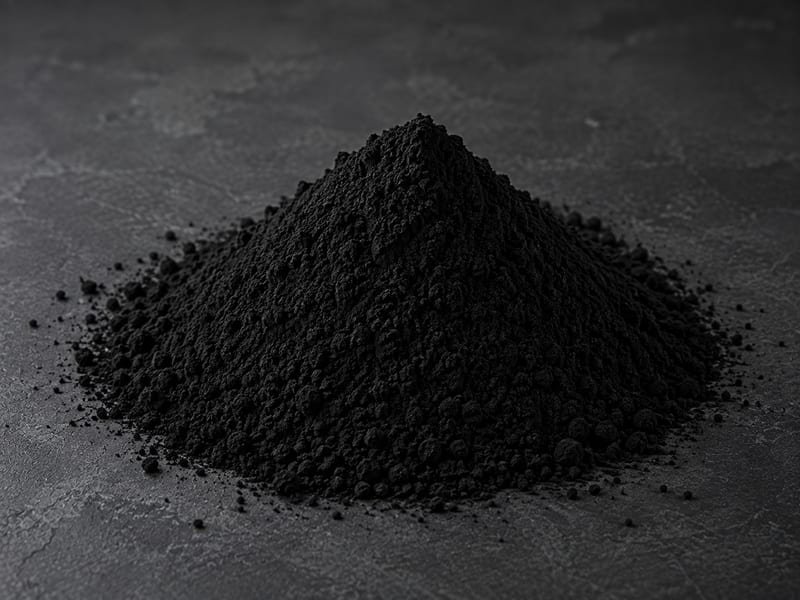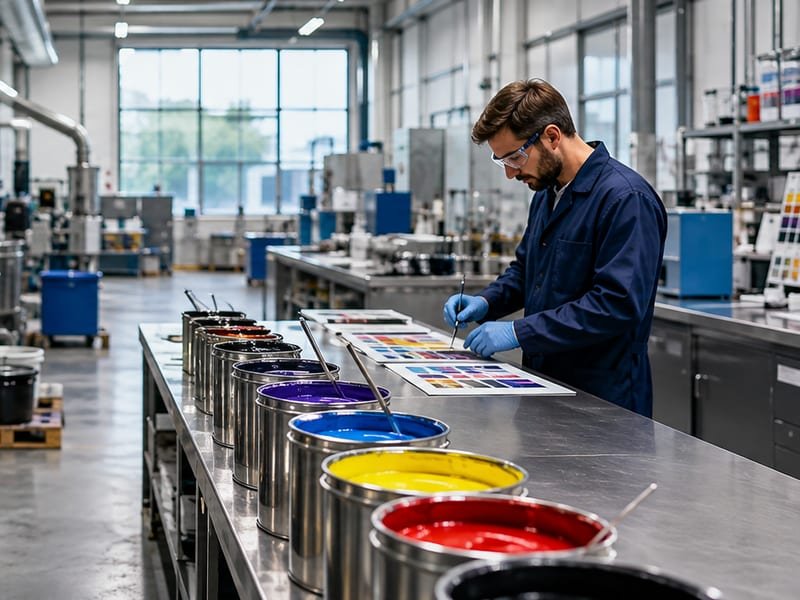
A brand-critical packaging black that reads perfectly matched on one press run and slightly warmer or weaker on the next isn’t necessarily a formulation error — it’s often carbon black surface area drifting within the same nominal grade, since surface area is what actually governs how deep, blue, or warm a black reads.
Root Causes
Carbon black pigment for printing inks exists at three structural levels: primary particles (roughly 10-100 nanometers), aggregates of fused primary particles, and agglomerates — reversible clusters of aggregates — and it’s the primary particle size and aggregate structure that define the colorimetric properties that matter for shade matching: undertone, optical density, gloss, and rheological behavior. Reducing particle size increases surface area, and higher surface area is documented as directly correlating with higher jetness (the depth and intensity of black) and increased tinting strength — which is why higher-jetness carbon blacks are specifically selected when a deep, rich black is the design requirement, and why BET specific surface area for ink-grade carbon black typically spans a wide 50-200 m²/g range depending on the grade.
Undertone is a related but separate property: smaller-particle-size carbon black grades are documented as enabling lower-viscosity inks with better coverage, optical density, blue undertone, and gloss compared with coarser grades — meaning two carbon blacks that both read as “black” pigment can produce a visibly warmer or cooler undertone in print depending on where their particle size falls. Because surface area and particle size are the parameters actually controlling shade, and because these are exactly the specifications that can drift subtly between production lots of a nominally identical grade, this is also the mechanism behind supplier-to-supplier grade consistency concerns — a different carbon black source claiming the “same” specification can still carry a different surface area distribution that shifts shade and dispersion behavior together.
What This Means for Raw Material Selection
Because shade and grade consistency both trace back to the same underlying particle-size and surface-area parameters, a buyer troubleshooting either a batch-to-batch shade drift or a supplier-switch consistency problem should look at the same data set: BET surface area and particle/aggregate size distribution, not just the grade name or a bulk color-strength check.
The practical points for a buyer are: specify BET surface area range explicitly for shade-critical formulations, not just the commercial grade name, since the documented 50-200 m²/g range spans meaningfully different jetness and undertone outcomes; request colorimetric verification (jetness, undertone, tint strength) per batch for brand-critical blacks, since these properties are the direct, testable output of particle-size consistency; and treat a supplier or lot switch as a full requalification event for surface-area-sensitive formulations, since matching the stated grade name doesn’t guarantee matching the underlying particle characteristics that drive shade.
Sources: Orion Carbons and Cabot (via Univar Solutions) specialty carbon black product selection guides for printing ink applications documenting BET surface area ranges and jetness relationships; HunterLab technical articles on carbon blackness, jetness, undertone, and tint strength measurement; Birla Carbon technical article on carbon black particle and aggregate size considerations in inkjet applications.