Perlite doesn’t just make concrete lighter — it makes it lighter along a predictable, documented curve, and knowing where a formulation sits on that curve is what separates a lightweight structural mix from one that’s too weak for its intended use.
Root Causes
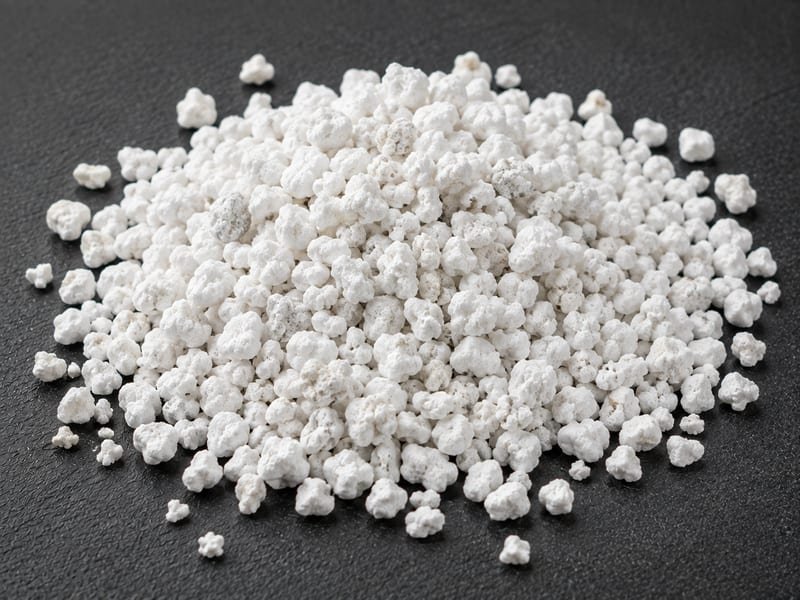
Expanded perlite in concrete delivers a documented set of benefits: increased workability, reduced unit weight, improved fire resistance, and better thermal and sound insulation, with weight reduction in the 20-30% range documented for concrete mixes incorporating perlite aggregate. This benefit isn’t free, however — the trade-off is compressive strength, and the mechanism is structural: perlite’s own porous particle structure is what delivers the insulation and weight benefits, and that same porosity makes the resulting concrete more prone to cracking and damage under load, with compressive strength documented as decreasing consistently as expanded perlite aggregate content increases.
The relationship isn’t a cliff — it’s a documented, usable curve: concrete mixtures prepared with 10% and 15% perlite aggregate content specifically are documented as retaining compressive strength above 30 MPa, a level sufficient to be used as structural concrete despite the strength reduction relative to a perlite-free mix. This means there’s a real, quantified dosage window where perlite’s weight and insulation benefits can be captured without crossing into non-structural territory — the trade-off is real but bounded, not an all-or-nothing choice between full strength and full lightweight performance.
What This Means for Raw Material Selection
Because the compressive-strength cost of perlite content is documented as a continuous, dosage-dependent curve rather than a fixed penalty, a buyer specifying perlite loading needs to target dosage against the specific strength requirement of the application, not choose between “structural” and “lightweight” as separate product categories.
The practical points for a buyer are: specify perlite dosage within the documented 10-15% range when the application needs both meaningful weight reduction and structural-grade compressive strength (above 30 MPa), since that’s the specific window shown to retain structural viability; push perlite content higher than that range only for genuinely non-structural applications (insulation boards, non-load-bearing plaster) where the weight and thermal benefit outweighs strength, given the documented consistent strength decline beyond the structural-viable range; and treat perlite-content strength testing as dosage-specific rather than assuming a single pass/fail threshold applies across all loading levels, since the documented relationship is a curve a formulator can target a point on, not a binary cutoff.
Sources: Springer Nature peer-reviewed research (International Journal of Concrete Structures and Materials) on durability of structural lightweight concrete containing expanded perlite aggregate; ResearchGate peer-reviewed research on the effect of expanded perlite aggregate dosage on properties of lightweight concrete; PMC/NCBI peer-reviewed research on fundamental properties of expanded perlite aggregated foamed concrete and lightweight reactive powder concrete containing expanded perlite.